
I primarily work in the cross-disciplinary domain of plasma astrophysics, integrating diverse areas of plasma physics, high-energy astrophysics, and astroparticle physics.
My research program combines analytical calculations with large-scale numerical simulations on supercomputers to investigate the emission processes and messengers—such as electromagnetic radiation, cosmic rays, and neutrinos—from a range of astrophysical sources. These include the Sun, accretion flows around black holes (e.g., Sagittarius A*, the supermassive black hole at the center of our galaxy), jets from active galactic nuclei (AGNs), gamma-ray bursts (GRBs), pulsar wind nebulae (PWNe), supernovae (SNe), tidal disruption events (TDEs), and other potential sources of ultra-high-energy cosmic rays (UHECRs).
Below, I have highlighted the main research areas I am currently focused on.
Particle Acceleration
Different physical processes in astrophysical plasmas can, under certain conditions, accelerate particles far out of thermal equilibrium. Non-thermal spectra of particles and radiation are inferred/observed in various astrophysical environments, such as supernova remnants, pulsar wind nebulae, active galactic nuclei, jets from black holes, or tidal disruption events. At the most extreme end of the accelerated particle spectrum are ultra-high-energy cosmic rays (UHECRs), particles with energies reaching approximately 1020 electron volts (eV), exceeding by 10 million times the energies of particles accelerated at the Large Hadron Collider (LHC) at CERN, the most powerful human-made particle accelerator. The mechanism by which astrophysical objects accelerate particles to such extreme non-thermal energies, necessary for explaining observed emissions and cosmic rays, remains a mystery. My research focuses on understanding, from first principles, how various plasma processes can accelerate these particles. By doing so, I aim to develop rigorous models to accurately interpret observational data and ultimately uncover the nature of astrophysical non-thermal sources.

Multi-Messenger Emission
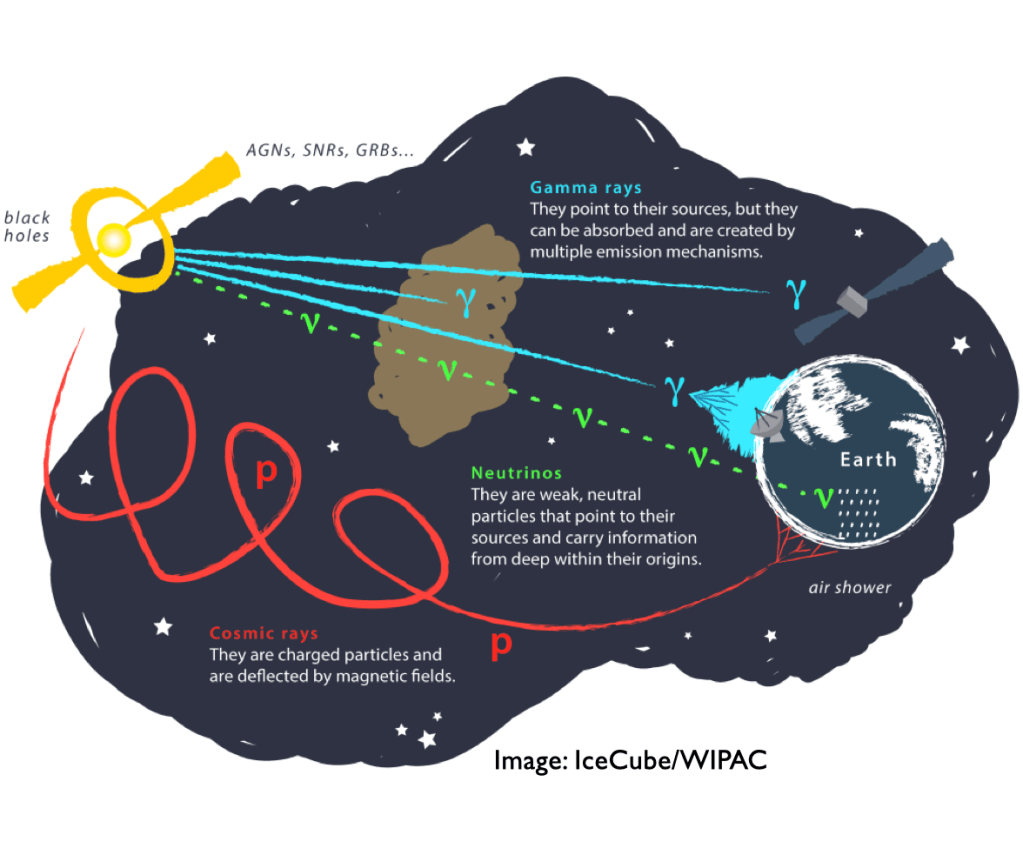
The multi-messenger approach consists of combining information from different cosmic messengers—electromagnetic radiation, gravitational waves, neutrinos, and cosmic rays—to uncover the mysteries of the universe’s most energetic events. This holistic strategy allows us to probe the complexity of intricate phenomena such as gamma-ray bursts, supernovae, flares from active galactic nuclei, and mergers involving black holes and neutron stars, which are often inadequately captured through a single observational channel. By modeling and synthesizing information from diverse messengers, and exploiting the cosmic ray-neutrino-photon connection, I aim to obtain a more comprehensive understanding of the mechanisms driving these events. I strive to develop robust physical models informed by first-principles numerical simulations, which can be tested against current and future observations. This comprehensive approach not only deepens our insight into astrophysical phenomena but also plays a crucial role in testing theoretical predictions in the fundamental laws of physics.
Plasma Processes around Black Holes and Neutron Stars
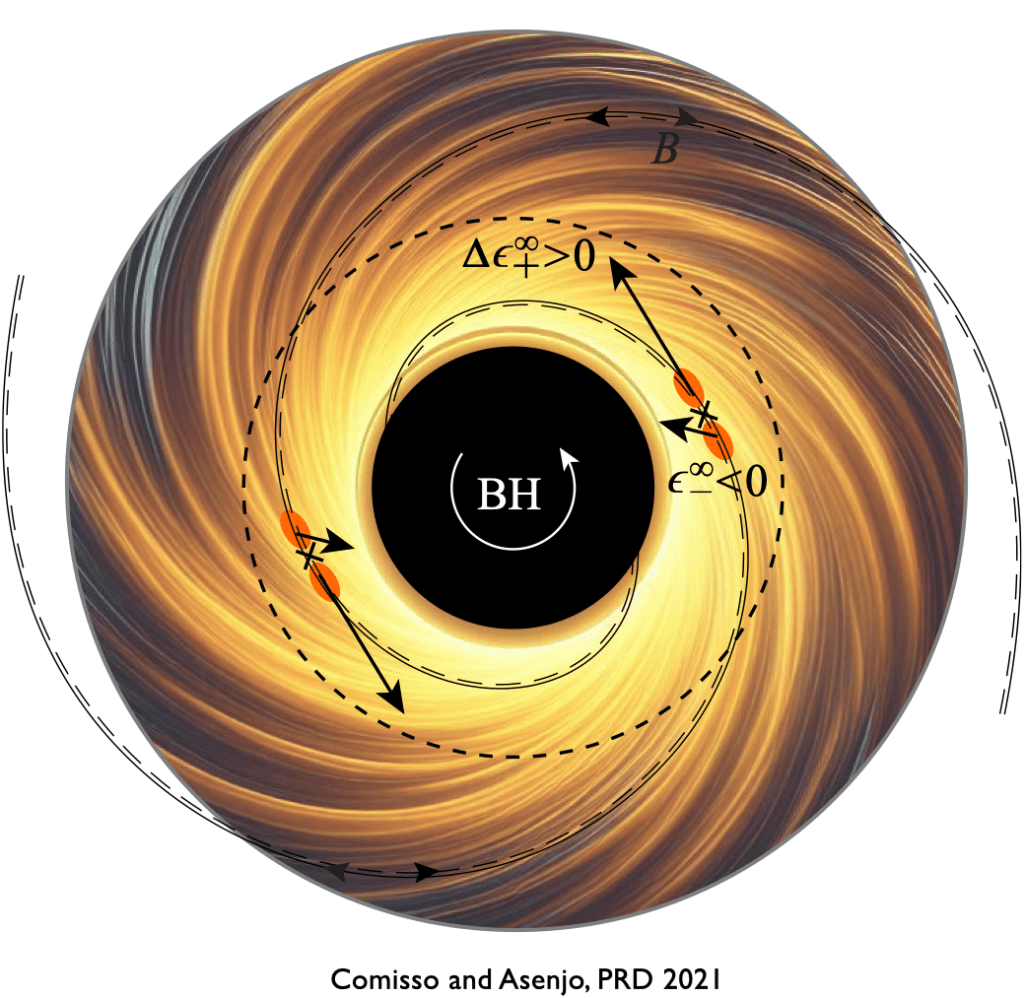
Black holes and neutron stars are among the most extreme objects in the universe. With the Event Horizon Telescope, we now have detailed images of the radiation emitted from the immediate vicinity of Sagittarius A*, the supermassive black hole at the center of our galaxy, and M87*, the black hole at the heart of the Messier 87 galaxy, which are reshaping our understanding of matter under extreme gravity. In addition to their intense gravitational fields, neutron stars possess extremely strong magnetic fields, with magnetars—the most magnetized neutron stars in the universe—surpassing even the critical quantum Schwinger field. In these extreme environments, strong gravity and quantum electrodynamics play essential roles in shaping the plasma behavior and need to be taken into account. My research aims to advance our understanding of the plasma dynamics under these extreme conditions, focusing on elucidating the mechanisms of black hole energy extraction, the generation of fast outflows (particularly relativistic jets), and the mechanisms underlying both quiescent and flaring emissions.

Plasma Turbulence
From the heliosphere to extragalactic plasmas, turbulence occurs in an extraordinarily wide range of circumstances. It is characterized by a broad spectrum of interacting scales, with energy transfer typically proceeding from large scales (energy-containing range) to small scales (dissipation range) through a cascade process. The chaotic nature of turbulent fluctuations undermines deterministic descriptions, yet they exhibit statistical patterns that can be systematically explored. Understanding the statistical properties of turbulence is crucial for addressing numerous astrophysical challenges, such as the transport of cosmic rays, the Sun’s coronal heating problem, and the heating of accretion disks around black holes. My research focuses on advancing our understanding of plasma turbulence through analytical analyses and state-of-the-art direct numerical simulations that leverage a variety of plasma model equations. The primary objective is to establish a robust theoretical framework and predictive capabilities for its statistical properties, applicable across diverse astrophysical contexts.
Magnetic Reconnection
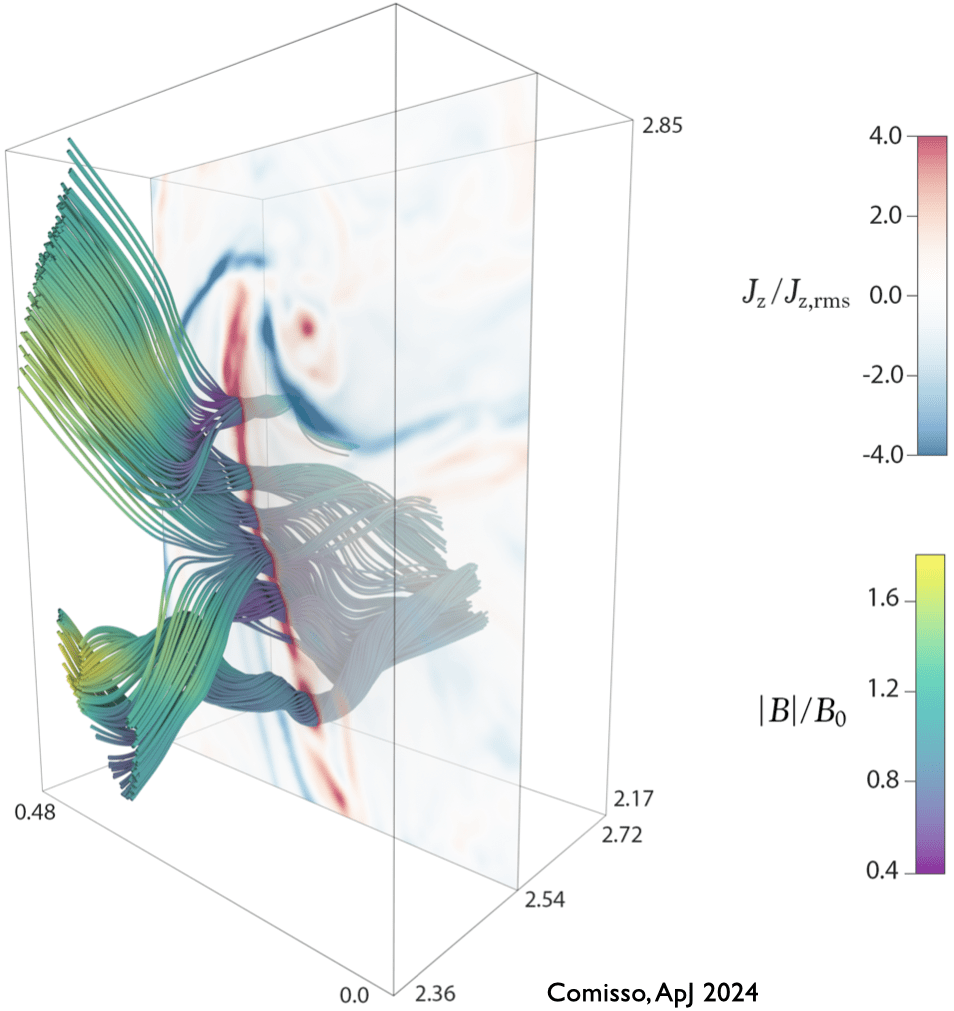
Magnetic reconnection is a plasma process whereby the magnetic field lines change their topological configuration, enabling a rapid conversion of magnetic energy into plasma kinetic energy. It is recognized as a key mechanism driving a variety of energetic phenomena, including stellar flares, stellar coronal mass ejections, planetary magnetospheric storms, and numerous other eruptive events observed around astrophysical objects. Understanding when, where, and how this occurs is crucial for explaining and predicting explosive events powered by the magnetic energy stored in these systems. My research focuses on addressing these questions using a range of physical models that incorporate different assumptions, including magnetohydrodynamics (MHD), two-fluid models, and the fully kinetic description. By employing a variety of models, my goal is to clarify how magnetic reconnection operates across different parameter regimes while also developing analytical solutions.
Plasma Instabilities
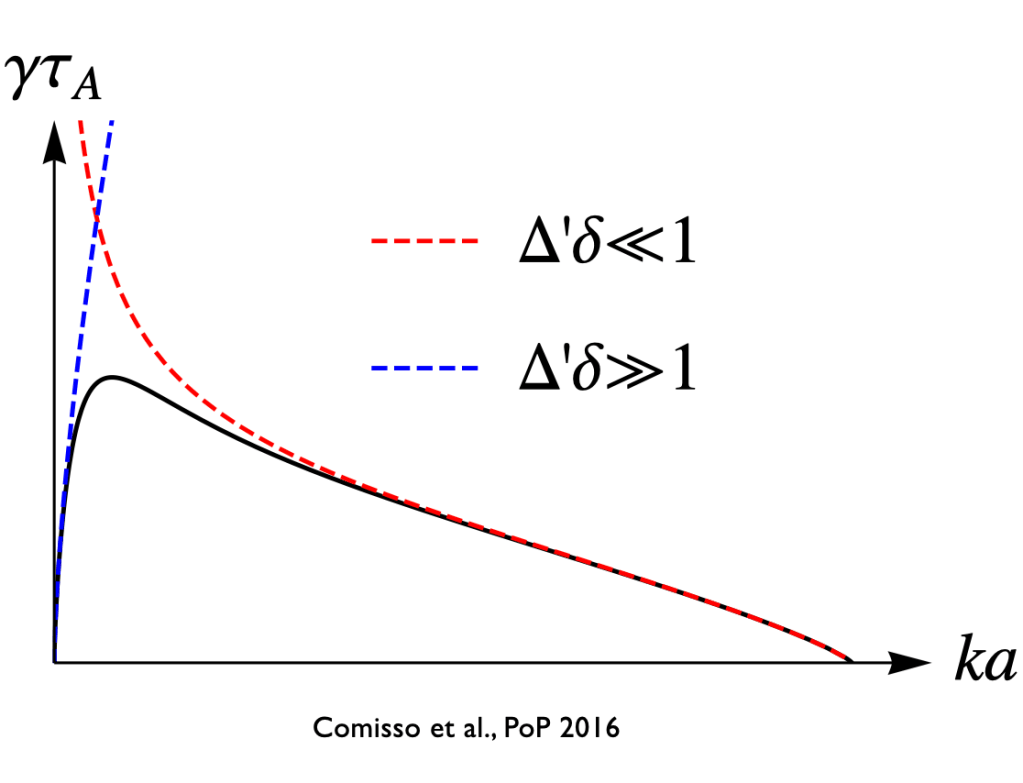
Plasma instabilities are pivotal in governing the behavior of plasmas across various astrophysical and laboratory settings. They can arise from a range of mechanisms, such as temperature gradients, velocity shears, pressure anisotropies, or gradients in the magnetic field, causing plasmas to depart from their equilibrium states. Determining the occurrence and exact properties of these instabilities is essential for predicting the plasma behavior in laboratory experiments and interpreting observations of astrophysical phenomena, as they significantly impact the plasma dynamics. My research on plasma instabilities spans theoretical analysis of the governing equations and direct numerical simulations aimed at validating the theoretical predictions and, when necessary, extending them beyond the regimes covered by analytic theory.
These research programs acknowledge support from:

 Luca Comisso